No. A pound of muscle and a pound of fat weigh exactly the same. Muscle is denser, so a pound of it takes up less room: about 1.06 grams per cubic centimeter versus roughly 0.9 for fat, which makes muscle around 18 percent denser by volume.
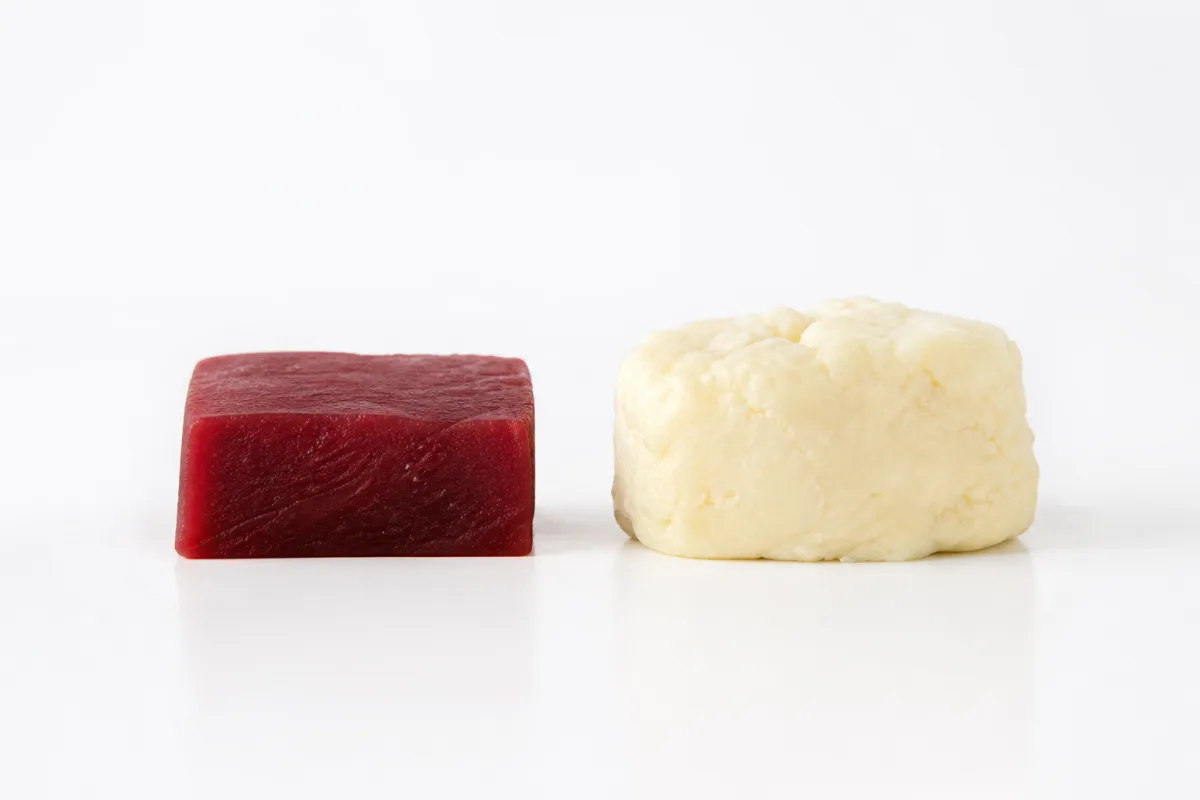
Here is where most articles on this topic go wrong, including the one that used to sit at this URL. They tell you muscle is denser, then show you a photo of a small red block next to a fat blob three times its size, and you walk away thinking a pound of fat is enormous compared to a pound of muscle.
It is not. Eighteen percent more volume works out to roughly six percent longer in each dimension. Real, measurable, and much subtler than the marketing. Those exaggerated foam props sold to gyms are a sales tool, and I have watched them set people up for disappointment when the mirror does not transform after four pounds.
So let me give you the accurate version, and then the thing that actually explains why your jeans fit better while the scale sits there mocking you.
How Much Denser Is Muscle Than Fat?
The density constants used in body composition science come from chemical analysis of human cadavers and underpin the two-compartment model behind hydrostatic weighing. In that model, fat mass is assigned a density of 0.9007 grams per cubic centimeter and fat-free mass 1.1000. These are the Siri and Brozek constants, in use since the early 1960s.
Skeletal muscle specifically sits near 1.06 grams per cubic centimeter, a figure traced to tissue measurements by Mendez and Keys in 1960. Divide 1.06 by 0.9 and you get 1.18. That is the whole basis for the 18 percent claim, and it is the honest ceiling on it.
Eighteen percent still matters, it just matters cumulatively. Swap fifteen pounds of fat for fifteen pounds of muscle and you have removed a meaningful amount of volume from your frame. That is two clothing sizes for a lot of people. It is simply not visible at four pounds, and telling someone otherwise sets them up to quit in week three.
Why Doesn't the Scale Move When You're Getting Leaner?
Density is not the answer to this question. Recomposition is.
When you start lifting and eat enough protein, two things run at once. You lose fat and you build muscle. If you drop five pounds of fat and add three pounds of muscle, the scale reports a two-pound loss. Your body just made an enormous change and the number barely flinched.
A 2016 randomized trial by Longland and colleagues at McMaster University, published in the American Journal of Clinical Nutrition, put 40 men in a 40 percent calorie deficit for four weeks while they trained six days a week. The higher-protein group gained 1.2 kilograms of lean mass while losing 4.8 kilograms of fat. The lower-protein group held its lean mass and lost 3.5 kilograms of fat.
Net scale change for the high-protein group was about 3.6 kilograms down. The composition change underneath it was roughly 6 kilograms of tissue swapped. The scale reported a little over half of what actually happened.
That gap between what changed and what the scale reported is the entire phenomenon. It is not muscle mysteriously outweighing fat. It is two opposite changes partly cancelling in a single number. I walk through the distinction in more depth in the difference between fat loss and weight loss, and the signal-by-signal version is in how to tell if you're gaining muscle or fat.
The villain is the bathroom scale, and the culture that made it the verdict. It measures one thing, total mass, and it cannot separate muscle from fat from water from the food in your stomach. Then it hands you a single number and an entire industry taught you to read that number as a grade on your effort. Judging twelve weeks of work by scale weight alone is like judging a film from one frame.
What Should You Track Instead?
At CoachCMFit I stopped letting the scale run the conversation years ago. Four signals, and the scale is the least important of them.

The 4-Signal Progress Check
Waist measurement weekly, progress photos every four weeks, logged strength every session, and how clothes fit. Scale weight is tracked but read last. When three of the four move the right direction, you are winning regardless of what the scale says.
| Signal | How Often | What It Tells You |
|---|---|---|
| Waist at the navel | Weekly, fasted, same morning | Fat change. Muscle adds almost nothing here |
| Progress photos | Every 4 weeks, same light and spot | What the mirror cannot see day to day |
| Logged strength | Every session | Whether you are building tissue or just losing weight |
| How clothes fit | Continuously, for free | Distribution, which no single number reports |
| Scale weight | Daily, read as a 7-day average | Direction of travel, nothing more |
On that last row: weigh yourself first thing in the morning, after the bathroom, before eating or drinking, and never react to a single day. Daily weight swings three to five pounds on water, sodium, and food volume alone. One reading is noise and the seven-day average is signal. The measurement methods and their real error rates are covered in how to track body fat percentage.
Why Chasing a Lower Scale Number Backfires
The people most fixated on a small number are frequently the ones sabotaging their own results. Calories get slashed, protein drops, cardio piles up, and the scale falls fast for two weeks. Most of that early drop is water, and a real share of the rest is muscle.
Then the metabolism adapts, the loss stalls, and what remains is a lighter, softer, weaker version of the starting point. That is the outcome nobody was chasing, and it is what happens when the measurement drives the plan instead of the other way around. If that pattern sounds familiar, how to fix skinny fat is the more specific read, and why the scale isn't moving covers the plateau case.

The defense is straightforward: keep loads heavy, keep protein high, and let the deficit be moderate rather than punishing. Resistance training is the signal that tells your body the muscle is worth keeping. Without it, weight loss takes whatever is available, and some of that will be tissue you spent years building. The mechanics are in body recomposition and how to reduce body fat percentage.
- Measure your waist at the navel tomorrow morning before eating. That single number will outperform the scale for this question.
- Take front, side, and back photos in the same lighting. You will want them in eight weeks.
- Start logging every working set. Rising strength with a flat waist is the signature of building muscle.
- Weigh daily if you want, but only ever read the seven-day average.
- Set protein near 0.8 to 1 gram per pound of bodyweight and keep the deficit moderate.
The honest summary is duller than the myth and more useful. A pound is a pound. Muscle is modestly denser, not dramatically. And the reason your body is changing faster than your scale is that two things are moving in opposite directions at once, which is exactly what you want and exactly what a single number can never show you.